
 Pay My Bills
 Report a Problem
 Start / Stop/ Move Service
 Business
 Contact Us
 Careers
Service Rates & Costs
We strive to maintain competitive rates while investing in a more sustainable future for our community. Use the information below to find the current rate schedule for your home or business.
All rates are effective as of October 01, 2025
Electric Rates
DemandLevel Charges
Pending approval by the Florida Public Service Commission. Effective November 2026.
| Tier | Demand | Residential | Small Business Commercial |
|---|---|---|---|
| Tier 1 | 0 — 7.999 kW | $5 (Orlando), $5.20 (St. Cloud) | $7.50 (Orlando), $7.80 (St. Cloud) |
| Tier 2 | 8 — 11.999 kW | $10 (Orlando), $10.40 (St. Cloud) | $15 (Orlando), $15.60 (St. Cloud) |
| Tier 3 | 12+ kW | $15 (Orlando), $15.60 (St. Cloud) | $22.50 (Orlando), $23.40 (St. Cloud) |
Miscellaneous Charges
| Description | Charge |
|---|---|
| Customer Charge This charge is applied when initiating an account at one service location in OUC’s records, or for transferring the account to a different location, and includes any combination of OUC services at a given location that are activated on the same service order on the same day. | $25.00 |
| Cut Seal Fee This fee is applied when OUC finds that a meter box seal has been cut by someone other than OUC and without OUC’s authorization but does not constitute utility theft/tampering or unauthorized use. | $100.00 |
| Electric Meter Test At a customer’s request, OUC will test a meter for accuracy at no charge once in a 12-month period. A second test may be requested within 12 months and carries this published charge unless the meter is found to be registering incorrectly. | One free test in 12 months $85.00 – 2nd test in 12 months |
| Electric Service Initiation Charge – No Meter Present When a new electric meter is set at a location that has not previously had service, this charge applies to cover the costs associated with travel and labor to perform the installation. | $170.00 |
| Electric Service Initiation Charge – Multiple Electric Meter Sets For multiple meters being set, the first meter is charged the full initiation cost and each additional meter is assessed a lower charge. To qualify for the reduced cost, the meters must be set at one location, in the same customer’s name, and during the same site visit. | $15.00 per meter |
| Electric Service Truck Trip Charge The cost for an electric service truck to make a trip to a customer’s location, which, upon arrival of the electric service truck, is not ready, causing additional trips. | $70.00 per trip |
| Field Trip Fee The cost for a field employee to travel to a customer’s location to perform work. Such work includes but is not limited to, unlocking/locking (sealing) meter bases, verifying that power or water is either on or off, or second trips after service was left off for safety reasons. | $35.00 |
| Late Payment Fee A late payment fee is assessed on the total unpaid past due amount five days after the due date. | 1.5% of total amount due or $5.00 (whichever is greater) |
| Non-Payment Removal/Reinstallation of a Water Meter This charge is applied when a water meter is removed due to non-payment issues or meter tampering. Reinstallation will only be performed during normal business hours. | $85.00 |
| Reread Meter – Electric & Water Upon request by a customer, OUC will reread a meter for accuracy at no charge once in a 12-month period. A second request will be charged unless it is determined that the previous reading was incorrect. | One free in 12 months $35.00 – second reread in 12 months |
| Returned Check Charge This charge is applied when a check, whether paper or electronic, is returned by the bank on which it is drawn. | $25.00 |
| Service Reconnect Fee at Meter This charge is applied when service is disconnected for non-payment of a bill. The bill must be paid to resume service. Once payment is made, digital meters will reconnect automatically. Payments made after 8 p.m. for disconnected analog meters will be reconnected the next day. | $45.00 weekdays 6 a.m. to 8 p.m., (excluding holidays) |
| Service Reconnect Fee at Transformer This charge is applied when a meter is not accessible to OUC personnel and service is disconnected at the utility pole for non-payment of a bill. The bill must be paid to resume service. | $225.00 weekdays 6 a.m. to 8 p.m., (excluding holidays) |
| Temporary Electric Connection Charge – “Saw Rig” This charge is applied when setting up temporary services for construction purposes. | $310.00 |
| Temporary Electric Underground Connection Charge – “TUG” This charge is applied for meter service of concrete block residential detached homes with underground electric service. | $170.00 |
| Theft/Tamper or Unauthorized Use of Service Investigation Charge This charge shall be in addition to the Utility Tamper Fee for all time beyond one hour and will be charged for expenses incurred in the investigation of theft of service, tampering, or the unauthorized use of service. | $115.00 per hour for all hours beyond one hour |
| Utility Tamper Fee The fee is applied when OUC finds that any meter has been altered or tampered with, or other utility equipment, in such a manner that would prevent a meter from registering utilities used by a customer. The customer will be charged for any damaged equipment. The customer’s account will be researched and then billed for any unauthorized or un-metered consumption that occurred as a result of the theft or tampering. A review of the customer’s deposit will occur. If necessary, an additional deposit may be assessed. | $200.00 for the first occurrence of meter tampering $400.00 for the second occurrence of meter tampering $800.00 for each additional occurrence after the second occurrence |
| Water Meter Test This service charge is applied when a customer requests a water meter assessment and it is determined the meter is registering accurately. If the meter is not registering accurately, there is no charge and the meter will be repaired or replaced. | 2” meters and smaller – $180.00 Meters larger than 2” – $430.00 |
In the event of any discrepancy between the rates published here and OUC’s Tariff filed with the Florida Public Service Commission, the Tariff rates shall prevail.
FAQs for Mid and Large Commercial Customers
What is demand (kW) vs. energy (kWh)?
Demand is the maximum amount of power, measured in kilowatts (kW), consumed at one point in time. Energy is the total amount of electricity consumed by the customer during the billing period and is measured in Kilowatt-Hours (kWh).
It’s similar to the relationship between a car’s speed and its odometer. The total distance the car travels (energy) is recorded by the odometer. The car will speed up and slow down, but as long as it is traveling, the odometer will continue to turn. The higher the speed of the car (demand), the faster the odometer turns.
How do demand and energy affect billing?
Demand is not determined by the amount of time your equipment is running. It is a function of how much power your equipment requires and how much of your equipment is running at a given time. The more equipment that operates simultaneously, the higher the demand.
Therefore, if your business requires sizeable peaks of energy—even if your equipment is only running for a short period of time—the amount of power it consumes (energy) at a point in time affects your bill. OUC must be able to supply the electricity and have the infrastructure in place to deliver the energy to you, such as power plants and distribution systems.
How is peak demand determined?
Most businesses have a meter that tracks and records demand in 15-minute intervals for each billing period. A customer is billed for the highest 15-minute kW demand used by their facility, known as peak demand. OUC must be able to provide that level of power in order for the customer’s equipment to run at its highest operating need.
How can I lower my Demand charges?
Your business energy auditor can help you determine if you qualify to move to a different rate class. Electricity use is charged differently depending on the rate class. Schedule a FREE Business Energy Audit. An OUC conservation specialist will visit your business and make recommendations based on your needs.
Tax Information for Commercial Customers
Taxes are levied on certain services by the State of Florida, the city, and the county based on the location where the service is provided. These taxes are collected by OUC on behalf of each taxing agency and remitted to each agency.
TYPES OF TAXES
Municipal Public Service Tax
This tax is imposed and administered by municipalities and charter counties and is governed by Chapter 166 of the Florida Statutes. Electric, water, fuel oil/kerosene, LP gas, manufactured gas, and natural gas utility services are subject to Municipal Public Service Tax. The cities of Edgewood, Orlando, St. Cloud, and Winter Park, in addition to Orange and Osceola counties, levy this tax on OUC’s customers.
Florida Sales Tax
Each sale in Florida is taxable unless the transaction is exempt. Sales tax of 6.95% is levied on the sale of Electricity by the State of Florida.
Discretionary Sales Surtax
This tax is collected when services are subject to state sales and use tax. Both Discretionary Sales Surtax and Florida sales tax are collected and remitted to the Florida Department of Revenue. The Department distributes the discretionary sales surtax to the counties where the surtax is levied. The counties use the funds to pay for locally authorized projects.
TAX EXEMPTIONS
Depending on the type of business, some OUC customers may qualify for exemption from certain taxes on their bill. Exemption from tax is granted by the taxing agency and requires documentation to be submitted to OUC.
By Email
By U.S. Mail
OUC – The Reliable One
Billing Operations, Tax Exemption Section
PO Box 3193
Orlando, FL 32802
For Questions
Contact customer service at (407) 423-9018
Florida Department of Revenue Taxpayer Assistance | (850) 488-6800
TYPES OF TAX EXEMPTIONS
| Customer Type | Documentation Needed |
|---|---|
| Agricultural/Farm | Any Good Faith Form or DOR’s Suggested Exemption Certificate Electricity Used For the Production, Packing, or Processing of Agricultural Products on a Farm, or Used in a Packinghouse |
| Churches | Consumer Certificate of Exemption from DOR (DR-5 Form). Form must show exemption for “Religious- Physical Place” |
| Government (i.e. School Districts, State Colleges, Dr. Phillips Center, GOAA, City of Orlando, etc.) | Consumer Certificate of Exemption from DOR (DR-5 Form) |
| Hospitals | Consumer Certificate of Exemption from DOR (DR-5 Form) |
| Manufacturing | Any Good Faith Form or Manufacturer Suggested Tax Exemption Form |
| Medical Facilities | Any Good Faith Form or OUC’s Nursing Home, Assisted Living Facility, or Home Health Service Exemption Certificate |
| Non-Profit Organizations | Consumer Certificate of Exemption from DOR (DR-5 Form) |
| Residential Common Use (common areas used by residents within an apartment community, HOA) | Any Good Faith Form or OUC’s Residential Household Affidavit |
Related Content
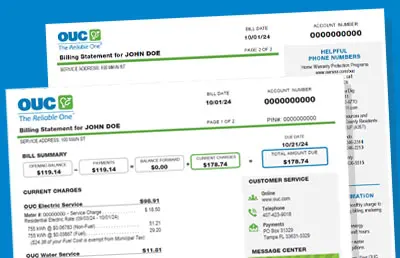
Understanding My Bill
Our sample bill can help explain all the details on your utility bill, so you know exactly what you’re paying for every month.
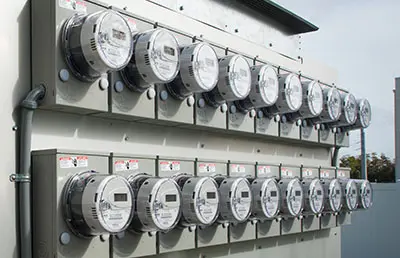
Digital Smart Meters
Learn how to read OUC’s digital meters so you can track your energy and water usage online on your myOUC account.
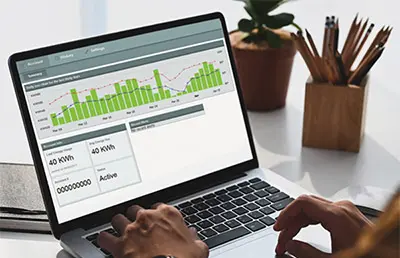
Usage Dashboard
Monitor your daily and hourly energy and water consumption with OUC’s Usage Dashboard. Set up alerts and view your usage trends.